
- WALL LIGHTS / WALL SCONCES
- PENDANT HANGING LIGHTS
- CHANDELIERS/JHUMAR
- CEILING MOUNT LIGHTS
- GATE AND GARDEN LIGHTS
- FOCUS LIGHTS
- STRING LIGHTS
- PICTURE LIGHTS
- PROFILE LIGHTS
- MIRROR BATH LIGHT
- READING LIGHTS
- CABINET LIGHTS
- CAMPING LIGHTS
- RECESSED LIGHTS
- STRIP LIGHTS
- DJ / STAGE LIGHT
- TABLE LAMPS
- FLOOR LAMPS
- LED STREET LIGHT
- LED BULBS
- TRACK LIGHT BASE / PATTI
- SURYA LED
- PANASONIC LED
A Comprehensive Guide on Smart Lighting in Nepal: What Is Available, What Is Worth It

Smart lighting lets you switch, dim, and schedule your lights from a phone, a voice command, a remote, or a sensor. In Nepal, you can now buy Wi-Fi bulbs, smart switches, and app-controlled strips, but prices, quality, and after-sales support vary a lot.
This guide covers what is available, what it costs, how Nepali homes change the choice, and which upgrades are worth your money. Prices are Sixkey prices as of November 2026.
The short answer: smart control pays off in the bedroom, the living room, and at the gate. Hallways and storerooms are better served by a standard LED. Smart lighting won’t noticeably cut your electricity bill, so buy it for comfort, convenience, and security.
What Counts as Smart Lighting?
Smart lighting is any light you can control beyond a plain on/off switch. In Nepal, you will come across seven main types.
- Smart bulbs: Fit a normal B22 or E27 holder and connect over Wi-Fi or Bluetooth. You can dim them, change the white tone and, on color models, pick from millions of colors. Check which holder you have before you buy.
- Smart wall switches: Replace your existing switch, so the lights already on that circuit become app-controlled. They suit homes that have already invested in a chandelier or pendant.
- Smart switch modules: Small relays that sit hidden behind a normal switch.
- Smart LED strips: Flexible strips with app control for TV backlights, ceiling coves, and under cabinets.
- Remote-controlled fixtures: LED ceiling lights and chandeliers that switch modes, color, or brightness from a remote, with no app or Wi-Fi needed.
- Smart ceiling fans with built-in lights: The Orient Aeroslim IoT BLDC ceiling fan has a warm white LED underlight with three brightness levels and works with the Orient Smart app, Google Home, and Amazon Alexa, according to Orient Electric.
- Automatic lights without an app: Sensor LED street lights from Panasonic and Surya for compounds and driveways, plus dusk-to-dawn outdoor lights. They need no Wi-Fi at all.
The same idea works at city scale. Under its City Bright program, the Nepal Electricity Authority has installed 11,500 smart street lights with local governments, controlled automatically from NEA’s central system (Spotlight Nepal, 2023).
Smart vs. Remote-controlled: Know the Difference
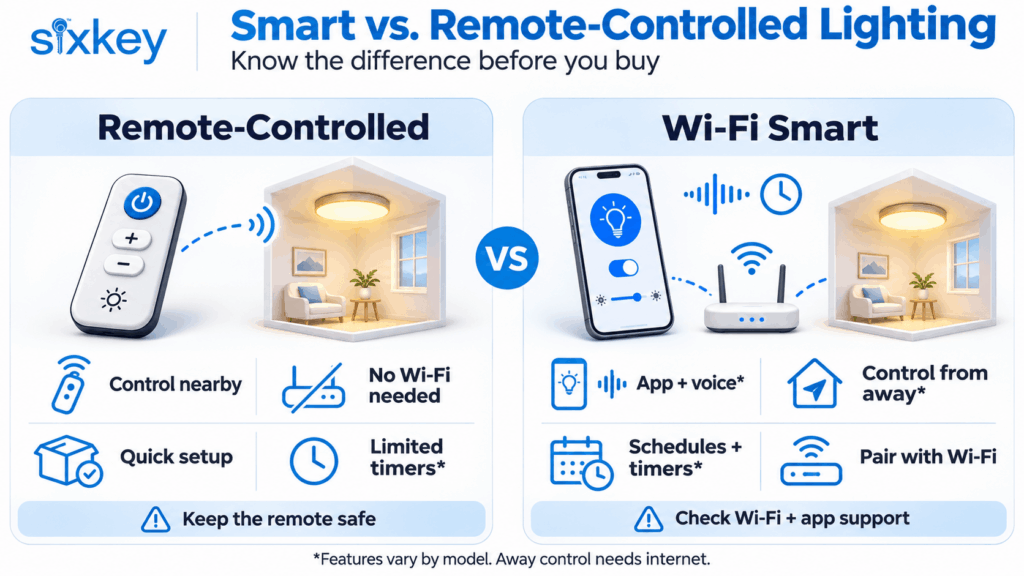
Some lights sold as “smart” are really remote-controlled. Both let you change the light without getting up, but they work differently. A remote talks directly to the light, so it only works inside the room. A smart light connects to your Wi-Fi, so you can control it from anywhere, by voice or on a schedule.
| Remote-controlled | Smart (app-controlled) | |
| How you control it | Handheld remote in the same room | Phone app, voice assistant, or schedule |
| Needs Wi-Fi or internet | No | Yes, for app and voice control |
| Works when the router is off | Yes | From the wall switch only |
| Schedules and timers | Limited or none | Yes |
| Control while you’re away | No | Yes |
| Setup | None; it works out of the box | Pair it with the app and your Wi-Fi |
| Main risk | Losing the remote | Weak Wi-Fi or an app the maker stops supporting |
Choose remote-controlled if you want simple mood changes in the living room or bedroom and nobody in the family wants an app. Choose smart if you want schedules, voice control, or control when you’re away, such as gate lights while the family is home for Dashain.
You don’t always have to pick one. At Sixkey, the color-changing outdoor focus light and the LED crystal chandelier come with a remote. The Orient Aeroslim IoT ceiling fan gives you both: a remote for everyday use, plus app and voice control for its built-in light.
How Much Does Smart Lighting Cost in Nepal?
A smart bulb doesn’t give you more light than a Rs. 200 LED. It gives you control, and whether that control is worth paying for depends on the room you put it in.
At Sixkey, lighting with remote or app control runs from Rs. 2,250 for a color-changing outdoor focus light to Rs. 23,850 for an app-controlled ceiling fan with a built-in LED light.
| Product | Control type | Price |
|---|---|---|
| 9W E27 LED bulb | Wall switch | Rs. 200 |
| Outdoor focus light, color-changing | Remote | Rs. 2,250 |
| Orient Aeroslim IoT BLDC ceiling fan with LED underlight | App, Alexa, Google Assistant, remote | Rs. 23,850 |
| Modern LED crystal chandelier for duplex ceilings | Remote | Rs. 175,500 |
Sixkey prices as of November 2026. Check the product page for the latest price.
Your total cost comes down to two choices: how many rooms you cover, and whether you replace bulbs or switches. You’re paying for control, not for more light. The upgrade only pays off where you’ll use that control every day.
Will It Work with Nepal’s Power Cuts and Wi-Fi?
Yes, if you check a few things before you buy. Each one takes a minute and saves you a return.
Match Your Wi-Fi Band
Fixed broadband now reaches 53.39% of Nepal’s population, according to Nepal Telecommunications Authority data (2026). Most Wi-Fi smart bulbs connect only on 2.4 GHz. If your router broadcasts 2.4 GHz and 5 GHz under one network name, pairing can fail. Split the bands in your router settings and pair the bulb on 2.4 GHz. Test the farthest room first.
Check What Happens When Power Returns
After a power cut, many smart bulbs switch back on at full brightness, even at 3 a.m. Before you buy, look in the product details or the app for a “power-on behavior” or “restore last state” setting. It brings the bulb back to the way it was before the outage.
Plan Your Inverter Backup
If your lights run on an inverter, your router needs backup too. When the router goes off, your smart bulbs still work from the wall switch, but app and voice control stop until the Wi-Fi comes back. Without any backup, a rechargeable emergency bulb keeps one room lit during an outage.
Confirm the Voltage Rating
Nepal’s supply runs at 230V, but low voltage and fluctuations still affect some areas, with reports from Bardiya and Bharatpur in 2026. Check the rated input range printed on the box. A wide range, such as 85 to 265 V, copes better with dips. Use a stabilizer if your area sees frequent voltage swings.
Check Your Switch Box Before Buying a Smart Switch
Most smart switches need a neutral wire in the switch box, and older wiring doesn’t always have one. No-neutral versions exist, but they can make low-wattage LEDs flicker. Pick a smart switch made for the same standard box size and gang count as your current switch plate, so it sits flush. Ask your electrician to check before you buy.
Buy Genuine, With a Local Warranty
The Nepal Telecommunications Authority requires type approval for Wi-Fi and Bluetooth devices before they are imported or sold. Many online listings for smart bulbs and switches carry no brand name and no warranty. Smart lighting also depends on its app, so choose a known brand with local support.
Does Smart Lighting Save Electricity?
Only a little. When it’s on, a smart LED uses about the same power as a regular LED. When it’s off, it stays connected to Wi-Fi and draws standby power. Tests reviewed by the IEA 4E Solid State Lighting Annex measured standby from 0.08 W to 3.5 W across 236 smart lamps.
NEA charges domestic users Rs. 9.50 per unit for 51 to 250 units a month. At that rate, 0.5 W of standby costs about Rs. 42 a year per bulb. Switching a 9W bulb off three hours earlier each day saves about Rs. 94 a year. The net saving of around Rs. 50 won’t repay the price gap with a regular LED. The real saving came when you switched to LED bulbs in the first place.
Is Smart Lighting Worth It for Your Home?
Smart lighting is worth it in rooms where you change the light several times a day. For hallways, storerooms, and staircases, a standard LED or a motion-sensor light is the better buy.
Where It Pays Off
Bedrooms come first. You can dim to warm light at night and switch everything off from bed. Warm evening light also suits sleep. A 2025 study in Scientific Reports estimated median melatonin suppression of 12.3% for cool white LEDs against 3.6% for warm white LEDs. Living rooms follow close behind, since one tap moves you from bright light for guests to low light for TV.
Outdoor and gate lights are the sleeper use case. If your family travels home for Dashain, a schedule keeps the compound lit on time while the house sits empty. For a no-app option, LED street lights from Panasonic and Surya come with a built-in sensor. Voice control also helps older family members who find wall switches awkward to reach. At Tihar, smart strips can run color scenes and switch off at a set time.
Where a Standard LED Wins
Low-use rooms don’t justify the price gap. Kitchens need bright, steady light whenever you’re in them, which a concealed LED panel handles well. Stairs and corridors rarely need more than a standard LED, or a motion-sensor light if you want them to switch themselves off.
The same goes for homes where everyone flips the wall switch out of habit. Once the switch is off, a smart bulb loses power and drops off the app until someone turns it back on. In that household, a smart switch module is the better choice because the switch itself stays smart.
Which Smart Lighting Fits Your Home?
The right system is the one that matches the phone and assistant you already use. Brand matters less than staying inside one app.
| If you… | Choose |
|---|---|
| Use an Android phone | Devices that list Google Assistant support, all in one app |
| Use an iPhone | Devices that list Apple Home or Matter support |
| Already own an Alexa speaker | Devices that list Alexa support |
| Already own fixtures you like | A Wi-Fi smart switch module |
| Want flexible lighting with no app or Wi-Fi dependence | Remote-controlled multi-mode fixtures |
| Want automatic light on stairs and paths | Motion-sensor lights |
If you expect to mix brands later, look for the Matter label. Matter is a shared standard backed by Apple, Amazon, Google, and others, so Matter bulbs work across their apps. It’s a bonus, not a must for your first bulb.
Smart-ready and Remote-controlled Lighting at Sixkey
Our range covers the remote-controlled side of smart lighting and the fixtures you’d pair with a smart switch. For outdoor areas, the color-changing outdoor focus light with remote lets you change colors from the veranda. For app and voice control in a bedroom, the Orient Aeroslim IoT BLDC ceiling fan combines a fan and a dimmable light in one fixture.
For rooms where a standard bulb makes more sense, our LED bulbs start at Rs. 100. Strip lights handle cove and accent lighting, and standard switches and sockets cover the rest of the room. Every product is genuine and comes from verified suppliers. Cash on delivery is available, and orders above Rs. 5,000 ship free inside Kathmandu Valley. Questions before you order? Order on WhatsApp at +977 9856028462.
Frequently Asked Questions About Smart Lighting
What is the price of LED light in Nepal?
Standard E27 LED bulbs cost Rs. 100 for 3W up to Rs. 350 for 18W at Sixkey. A 9W bulb costs Rs. 200. PAR 30 LED bulbs for focus and display lighting cost Rs. 1,500 to Rs. 2,500.
Is smart lighting good for homes in Nepal?
Smart lighting works well in Nepali homes when the setup accounts for local conditions. That means a 2.4 GHz Wi-Fi network, router backup on the inverter, and bulbs with a power-on memory setting. It delivers the most value in bedrooms, living rooms, and outdoor lights on schedules.
Do smart bulbs need a hub?
Wi-Fi smart bulbs don’t need a hub. They connect straight to the home router. Zigbee-based bulbs need a Zigbee hub or gateway, which adds to the upfront cost.
Can smart lights work without the Internet?
A smart bulb still turns on and off from the wall switch without internet. Wi-Fi bulbs that rely on the brand’s cloud service lose app and voice control during an outage. Remote-controlled fixtures don’t use the internet at all, so an outage doesn’t affect them.
Does Sixkey install smart switches and lights?
Sixkey does not install. Inside Kathmandu Valley, we can help arrange an electrician on request. Outside the Valley, customers arrange their own electrician.
Start With One Room
Don’t wire the whole house on day one. Put smart control in the room where you adjust lighting most, live with it through a few power cuts, and then decide what to add. For most homes, that first room is the bedroom, and a single smart switch module or remote-controlled fixture is enough to get started.
When you’re ready to plan the rest of the house, our guide to modern lighting ideas for Nepali homes helps you match the light to how each space gets used.