
- WALL LIGHTS / WALL SCONCES
- PENDANT HANGING LIGHTS
- CHANDELIERS/JHUMAR
- CEILING MOUNT LIGHTS
- GATE AND GARDEN LIGHTS
- FOCUS LIGHTS
- STRING LIGHTS
- PICTURE LIGHTS
- PROFILE LIGHTS
- MIRROR BATH LIGHT
- READING LIGHTS
- CABINET LIGHTS
- CAMPING LIGHTS
- RECESSED LIGHTS
- STRIP LIGHTS
- DJ / STAGE LIGHT
- TABLE LAMPS
- FLOOR LAMPS
- LED STREET LIGHT
- LED BULBS
- TRACK LIGHT BASE / PATTI
- SURYA LED
- PANASONIC LED
Proper Lighting: How to Make Every Room Feel More Comfortable

Proper lighting is light matched to what a room actually does, at the right brightness, in the right combination of sources, at a color temperature that suits the task. It isn’t the number of fixtures on your ceiling or the wattage on the box. A living room with a single bright overhead light and nothing else isn’t well-lit, even if every corner is visible, because it has no layers and nowhere to dim for evening use.
By the end of this article, you’ll have the brightness numbers, color temperature ranges, and sizing math for a Nepali living room, ready before you buy a single fixture.
In this guide
What is Proper Lighting?
Proper lighting is the combination of enough light, from the right number of sources, at a color temperature suited to the task, arranged so no part of a room sits in shadow or gets blown out by glare. It’s a functional standard, not a decorating choice.
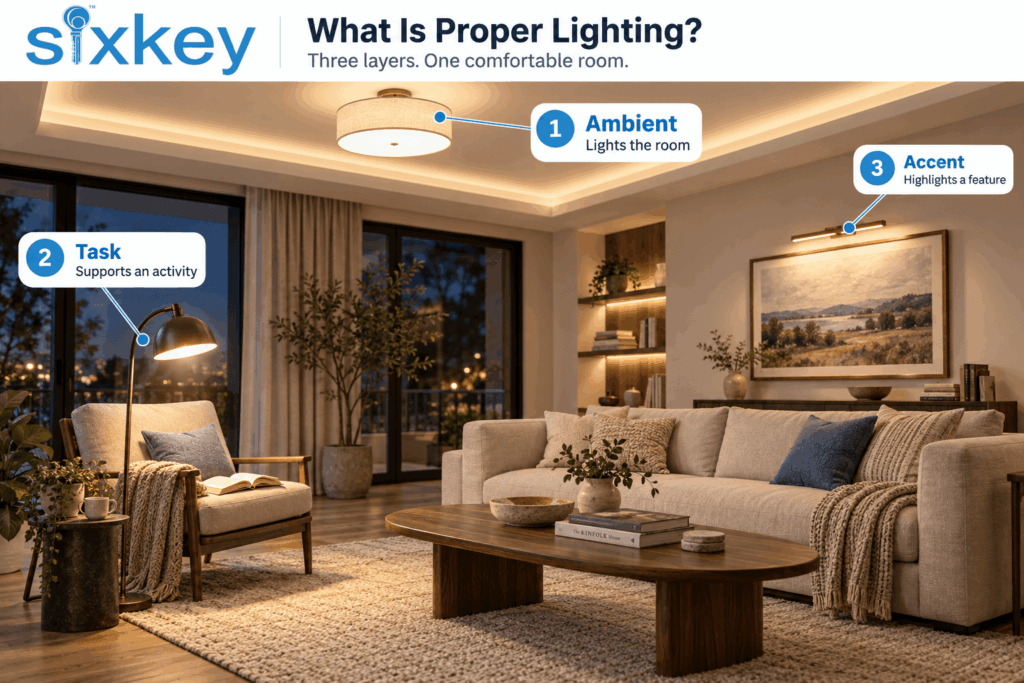
That standard rests on three layers working together. Ambient light fills the room as a base level, usually from a ceiling fixture or a set of downlights. Task light targets a specific activity, a reading lamp beside a chair, a fixture over a kitchen counter, a desk lamp in a home office. Accent light draws attention to something specific, a piece of art, a display shelf, an architectural feature, and does almost nothing for general visibility.
Most rooms need at least two to three different light sources working together, and most living spaces need all three layers. A single ceiling light checks the ambient box and stops there, which is why so many living rooms feel flat and over-bright at once, evenly lit but with nowhere warm to sit in the evening.
Why Proper Lighting Matters in Your Home
Proper lighting matters for four concrete reasons: it improves how well you can do everyday tasks, it affects your eyes more than most people assume, it shapes a room’s mood, and it prevents everyday problems most people never trace back to lighting.
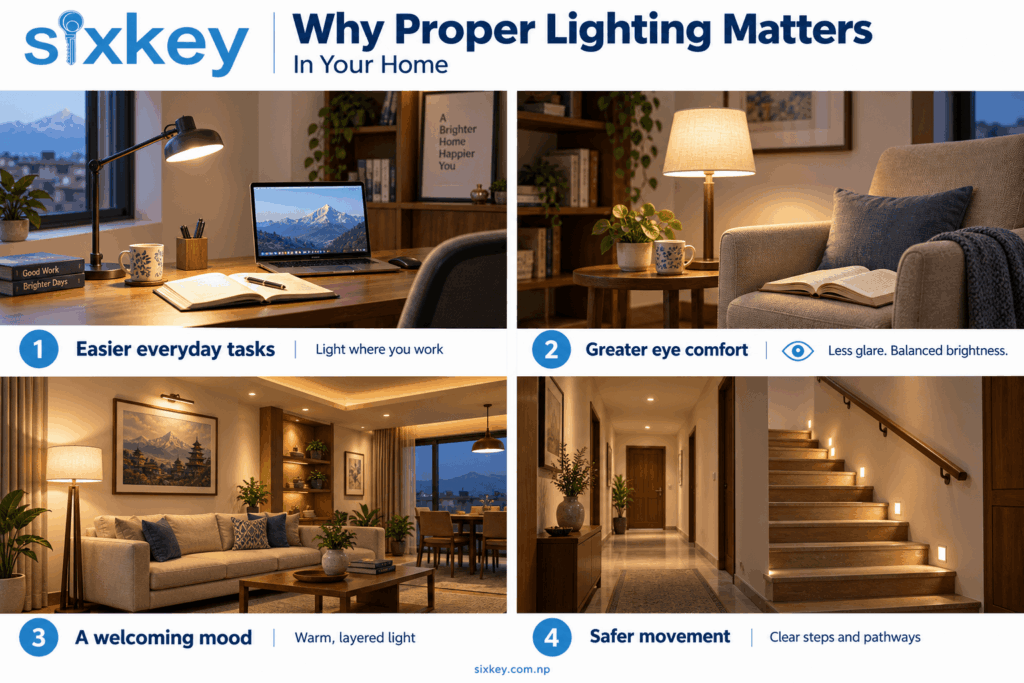
1. It Changes How Well You Can Actually Do Things in a Room
Proper lighting can enhance task performance in ways most people underestimate. Reading, cooking, folding laundry, and working from a home office all need meaningfully more light than a room needs to simply look occupied. Residential lighting standards put task-area brightness at several times the level of general ambient light , which is why a kitchen counter or a home office desk lit only by the room’s overhead fixture never quite feels bright enough for the work happening under it.
Home offices are the clearest example. A desk lit for the room’s general ambiance, rather than for the screen and the paperwork on it, forces your eyes to keep readjusting between a bright monitor and a dim desk. That’s the kind of task-performance gap proper lighting is built to close, and it’s as relevant to someone working from a spare bedroom as it is to a full living room.
2. It Affects Your Eyes More Than Most People Realize
Appropriate lighting can reduce eye fatigue and headaches, and poor room lighting is a documented contributor, not just a comfort issue. The American Optometric Association lists poor lighting and screen glare among the leading causes of computer vision syndrome, and specifically recommends repositioning a screen to avoid glare from overhead lighting or windows rather than just lowering the brightness on the device itself. That’s the same fix a mismatched home office, a bright ceiling light and a dim desk with glare off the monitor, actually needs.
There’s a common myth worth correcting here too. Reading in dim light causes temporary eye strain, not permanent damage, a distinction a 2007 review in the British Medical Journal traced back decades (Vreeman and Carroll, 2007). The discomfort is real. The damage isn’t. Which is still a good reason to fix the lighting rather than push through it.
3. It Sets The Mood, Not Just the Visibility
Layers of light create drama and interest in a way a single flat source never can. A living room with ambient light dimmed low and an accent lamp lighting one wall reads completely differently from the same room lit only by a ceiling fixture at full brightness, even though the furniture hasn’t moved. This is where proper lighting stops being purely functional and starts doing design work, and it’s also where color temperature matters most, since a cool white accent light kills the mood layered lighting is meant to create.
4. It Has Practical, Everyday Payoffs Beyond the Obvious
Proper lighting can also have some practical benefits in your home that have nothing to do with atmosphere. A well-lit staircase or hallway cuts the chance of a trip in the evening. A kitchen with real task lighting over the counter, not just ambient light from across the room, makes chopping and prepping safer. And a home that’s properly lit photographs and shows better, which matters if you’re renting, selling, or just have guests over during Dashain, Tihar & other festivities.
How to Choose Proper Lighting for Every Room
Choosing proper lighting comes down to five decisions: how many light sources a room needs, how bright each one should be, what color temperature to use, where to place fixtures, and whether the driver can handle Nepal’s power supply.
Layer Your Light Sources, Don’t Rely on One Fixture
Start with ambient light sized to the room, then add task light wherever an activity happens: a chair, a counter, a desk. Add accent light last, and only where there’s something worth drawing attention to, a pendant light over a reading nook or a wall light beside a piece of art. Most rooms need two to three of these sources working together. A single ceiling fixture is a start, not a finished plan.
Match Brightness to the Room’s Job
Living rooms and bedrooms generally sit around 100 to 300 lux of ambient light. Task areas run far brighter, kitchens and home office desks typically need several times that where the work actually happens. Proper brightness levels ensure comfort and usability, and the mistake most Nepali homes make isn’t too little light overall, it’s the wrong amount in the wrong spot. Sixkey’s ceiling mount lights range covers this ambient layer from around Rs. 147 for a basic panel up to decorative fixtures near Rs. 32,500, and it’s usually the first thing worth sizing correctly before adding task and accent light on top.
Get the Color Temperature Right
Stay between 2700K and 3000K for living rooms, dining rooms, and bedrooms. That warm range flatters skin tones and most interior finishes. Reserve cooler temperatures, 4000K and above, for kitchens, home offices, and bathrooms, where the work benefits from a crisper light. Mixing a warm ceiling fixture with a cool desk lamp in the same room is one of the most common lighting mistakes there is, and it undoes the layering work before it starts.
Size and Place Fixtures for the Room, Not the Showroom Photo
A rough sizing rule that works for most Kathmandu living rooms: add the room’s length and width in feet, and treat that number in inches as a starting fixture diameter. A 12 by 14 ft living room points to a fixture around 26 inches wide. Over a desk or reading chair, placement matters more than size. Light should fall on the work, not behind the person doing it, casting a shadow across the page or the keyboard.
Account for LED Driver Quality and Nepal’s Power Supply
Most proper lighting today runs on integrated LED, which puts real weight on driver quality that a lot of buying guides skip entirely. Nepal’s power supply isn’t as consistent as it is in markets where these buying guides are usually written, and an unstable supply is harder on a sealed LED driver than on a room with steady voltage. Ask two questions before buying an integrated fixture: what warranty covers the driver, and can it be replaced separately from the frame. Sixkey’s LED bulbs range spans the 2700K to 4000K temperatures this guide recommends, priced from Rs. 100 to Rs. 2,500. A fixture with a serviceable driver holds up far longer than one that doesn’t.
Find the PROPER Lighting at Sixkey
A comfortable, well-lit home starts with choosing the right light for each space. Build an even base of ambient light, add focused lighting where you read or work, and use accent lights to highlight the details you love.
Make Sixkey your go-to online lighting store in Nepal. From ceiling lights and pendants to table lamps and wall lights, explore options for each layer in one place. Start with Sixkey’s ceiling mount lights and build a lighting setup around how you live.
Frequently Asked Questions
What is proper illumination?
Proper illumination is the same idea as proper lighting, adequate brightness for the task, distributed across the right number of sources, at a color temperature suited to the room. “Illumination” gets used more in technical or engineering contexts, while “lighting” is the everyday term for the same standard.
What is proper lighting in the workspace?
Workplace lighting follows the same layering principle but at higher brightness, with cooler color temperatures around 4000K to support alertness during the day. A home office should borrow from this standard rather than from living-room lighting, since the work happening there needs office-level brightness, not living-room ambiance.
Does proper lighting really reduce eye strain?
Yes, when the mismatch causing the strain gets fixed. Most eye strain from lighting comes from a gap between two sources, a bright screen against a dim room, or a cool desk lamp under a warm ceiling fixture, not from insufficient light on its own. Matching brightness and color temperature across a room’s sources addresses the actual cause.
How many light sources should a room have?
Two at minimum, three for most living spaces. One source covers ambient light, a second covers whatever task happens in that room, and a third, where relevant, handles accent lighting for a specific feature. A single overhead fixture rarely satisfies more than one of these roles at once.
Do you deliver lighting products outside Kathmandu?
Yes. Sixkey delivers nationwide through third-party logistics partners, with free shipping inside the Kathmandu Valley on orders above Rs. 5,000 and cash on delivery available on eligible orders. For remote or rural districts, confirm delivery availability with the team before ordering.