
- WALL LIGHTS / WALL SCONCES
- PENDANT HANGING LIGHTS
- CHANDELIERS/JHUMAR
- CEILING MOUNT LIGHTS
- GATE AND GARDEN LIGHTS
- FOCUS LIGHTS
- STRING LIGHTS
- PICTURE LIGHTS
- PROFILE LIGHTS
- MIRROR BATH LIGHT
- READING LIGHTS
- CABINET LIGHTS
- CAMPING LIGHTS
- RECESSED LIGHTS
- STRIP LIGHTS
- DJ / STAGE LIGHT
- TABLE LIGHTS
- FLOOR LAMPS
- LED STREET LIGHT
- LED BULBS
- TRACK LIGHT BASE / PATTI
Understanding Track Lighting: Types, Benefits and Buying Guide

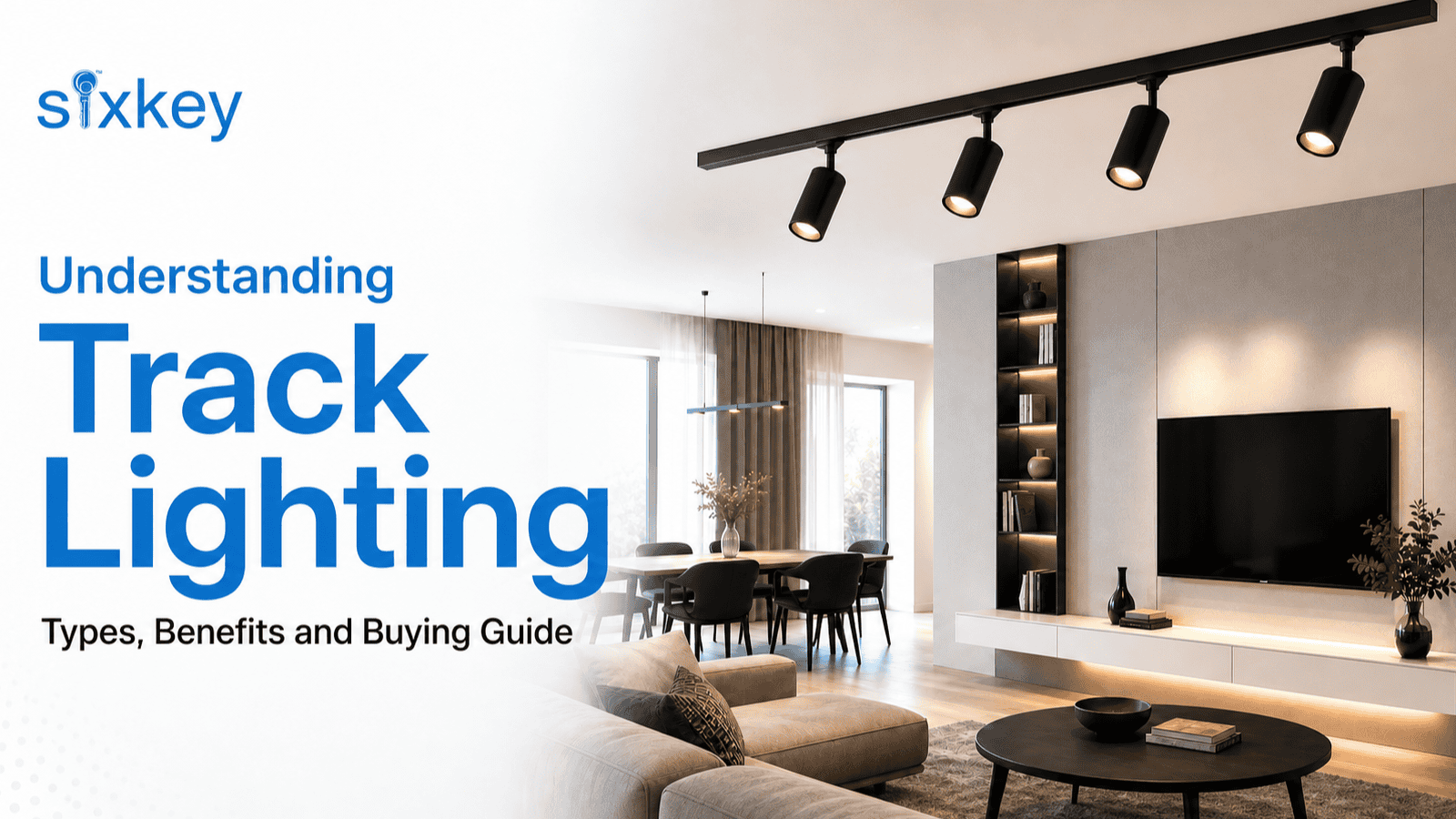
Track lighting is a mounted rail that carries power to individual light heads, each positioned anywhere along its length. Instead of one fixed ceiling fixture, you get a row of adjustable heads that aim light where a room actually needs it. This guide covers the types that matter, the real pros and cons, and what to check before you buy for a Nepali home.
In this guide
What Is Track Lighting?
Track lighting is a modular system with three parts: a track (the rail or bar), a power feed that ties it into your home’s wiring, and light heads that clip onto the rail and slide anywhere along it. Current runs through the track the whole time, so a head lights up the moment you snap it on. Adding a fixture takes a free slot on the rail, not new wiring.
That’s the whole appeal. A single flush-mount fixture lights one spot and stays there. A track spreads several adjustable heads across a run, so one circuit can cover a kitchen counter, a feature wall, and a reading corner at once. Move or angle the heads as the furniture shifts or the room changes use.
Every setup breaks down into the same three parts:
- Track. Carries current along its length and comes in fixed sections that join with connectors for longer or shaped runs.
- Power feed. Connects to your home supply, either hardwired into a ceiling point or, on plug-in versions, run to a wall socket. The plug-in route suits rented rooms or spaces with no ceiling wiring.
- Light heads. Lock on by hand and pull power straight from the rail, so re-aiming one takes seconds and no tools.
Most conventional track runs on Nepal’s 230V mains. Low-voltage systems, including magnetic track, drop that down through a driver, which allows slimmer heads and keeps the mains voltage off the fixtures. Tracks mount to the ceiling in straight, L-shaped, U-shaped, or rectangular runs, or to a wall in place of a fixed vanity light.
Types of Track Lighting
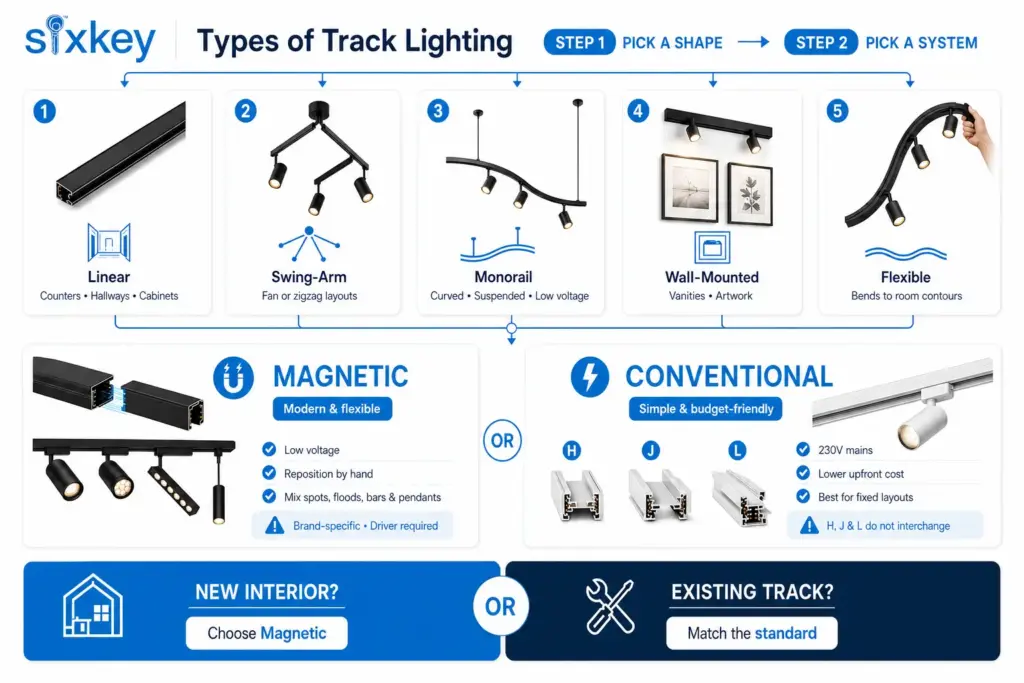
“Types of track lighting” actually covers two separate questions: what shape does the track take, and which electrical standard does it use? Both matter when you shop.
Track Shapes and Mounting Styles
Linear track is a straight rail, the common configuration, and it works over a kitchen counter, along a hallway, or above a run of cabinets. Swing-arm track anchors at its center with jointed sections that pivot, so you can angle the arms into a fan or zigzag for an awkward room shape.
Monorail hangs from standoffs rather than sitting flush, often in curved runs for a softer look, and it usually operates at low voltage. A wall-mounted track works as an adjustable stand-in for a bathroom vanity bar or a picture light. Flexible track, sold by some brands as a bendable rail, curves by hand to follow a room’s contours.
Track Systems: Magnetic and Conventional
Magnetic track is the modern low-voltage option and the best fit for most new interiors. Modules hold to an aluminum channel magnetically, with no exposed live contacts, and you reposition them by hand. One channel combines spots, floods, linear bars, and pendants on a single run, covering accent, task, and ambient light. Because the modules sit behind a driver, Nepal’s 230V mains and voltage swings never reach the fixtures. The trade-offs are real. It’s proprietary, so modules don’t cross brands, each run needs its own driver, and it costs more upfront than a conventional rail. Pick it for a new build or modern refit where you’ll rearrange often, not for a tight budget or a retrofit into older track.
Conventional track runs on 230V mains and costs less upfront, which suits a fixed run you won’t rearrange much. If you’re extending an existing imported track, the older H, J, and L standards don’t interchange, so match what you already own. Count the wires in the rail to identify it, or bring a head when you shop. For a new install, you’re not tied to any of these, so choose on head fit and finish.
Track Head Styles
Once the shape and system are settled, the head style is mostly about looks. Cylinder heads are the basic, widely available shape. Round-back heads give a smoother, modern profile, gimbal heads rotate in a bracket for precise aiming, and pinhole heads expose the bulb for an industrial edge. Stepped heads flare in tiers for a more decorative silhouette, barn-door heads add flaps to shape the beam, and some systems let you drop a small pendant onto the same rail for a mixed look.
Where Track Lighting Works Best
Track lighting works best wherever a room needs light aimed at specific spots instead of one fixed glow. In the kitchen, it goes over a counter or an island, putting task light on the work surface during prep. Living rooms use it to graze light across built-in shelving, a feature wall, or artwork that changes over time. Along a hallway or a gallery run, evenly spaced heads wash framed pieces without hotspots. A home office or studio uses a single run over the desk to land directional light exactly where close work happens.
Magnetic track fits this brief better than any other system in a modern flat. One recessed channel carries accent spots, a linear bar for ambient fill, and a pendant module over the table, so a single run does the work of three separate fixtures. That’s the clean, built-in look most new Kathmandu apartments are designed around, and re-aiming a module as the room changes takes seconds. For an open-plan living and kitchen space where one ceiling run has to cover cooking, eating, and relaxing, it’s the most flexible choice on the market.
Advantages of Track Lighting
The case for track lighting comes down to flexibility, and a few things make that flexibility pay off in a real room.
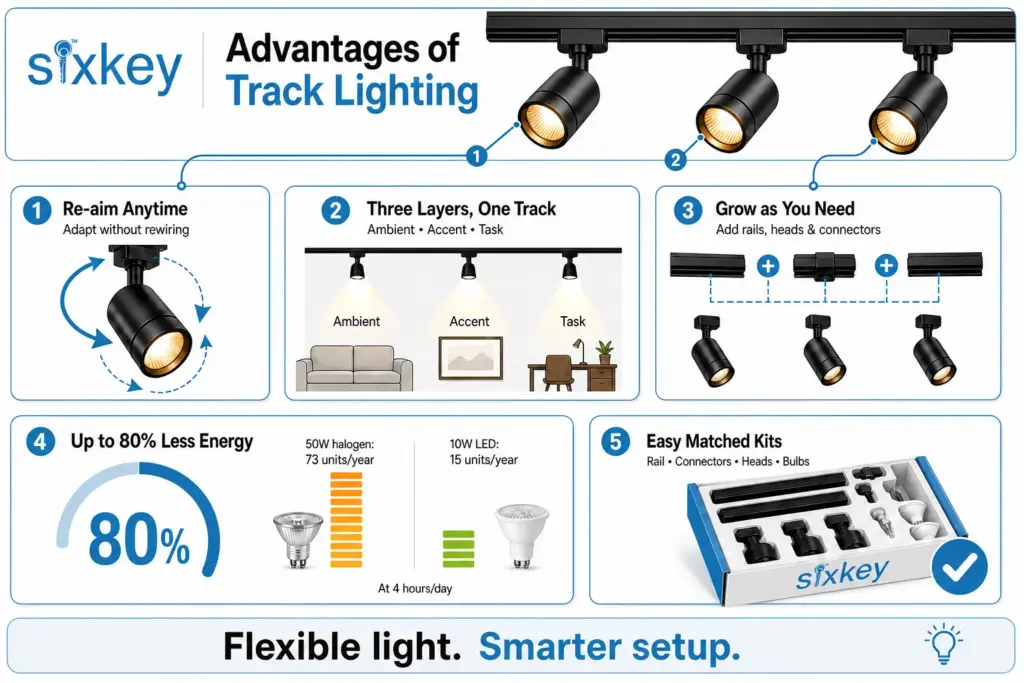
- Adapts without rewiring. Slide or re-aim the heads to follow a new layout, a repainted wall, or artwork you’ve swapped in. No electrician, no new wiring. A fixed recessed light stays pointed at one spot for good.
- Layers light on one circuit. Ambient fill, accent on a shelf, and task light over a desk all come off the same run, just by aiming heads differently.
- Grows with the space and budget. Start with a short run and three heads, then add sections and connectors later as you need them.
- Cheaper to run with LED. LED draws far less power than halogen and lasts far longer, which matters on a supply that swings as much as Nepal’s. A 50-watt halogen spot run four hours a day burns about 73 units a year. A 10-watt LED doing the same work draws roughly 15, close to an 80 percent cut, before you count the bulbs you never replace.
- Simple to buy as a kit. A matched kit bundles the rail, connectors, and heads, often with bulbs, so nothing turns up mismatched.
Disadvantages of Track Lighting
Track lighting isn’t the answer for every room. A few trade-offs are worth weighing first.
- Systems lock you in. Once you commit to a magnetic system or a conventional standard, every later head and connector has to match it. Magnetic modules don’t cross brands at all, so replacing a discontinued run can mean replacing the whole thing.
- Circuit capacity caps the head count. Every head adds load, and going over the circuit’s rated wattage risks a tripped breaker or an overloaded line. Total the wattage of all your planned heads and confirm the circuit can carry it before a big run goes in. Inside the Kathmandu Valley, Sixkey can arrange an electrician to check capacity and handle the install.
- Exposed heads can glare. The bulb sits in an open or semi-open fixture, so a badly angled head shines straight into your eyeline. Aim heads at the wall or object they light, not out into the room.
- Hardwired runs need an electrician. A fresh hardwired run, especially where there’s no ceiling point already, isn’t a bulb swap. A plug-in system or a straight fixture swap is far easier.
- More fixtures mean more cleaning. Each head is another surface that collects dust, and open-back styles like pinhole show it faster than enclosed fixtures.
Buying Track Lighting: What to Check First
Work through these before you order. They’re roughly in order of priority, so the early ones save you the most grief.
- Confirm the system first. If you’re extending an existing track, match its system before anything else, since heads and connectors won’t cross between magnetic and conventional or between older conventional standards. Counting the wires in the rail identifies a conventional track, as covered in the types section above. For a new install you’re choosing fresh, so this is about fit and finish, not matching legacy parts.
- Match the bulb to the job. LEDs draw the least power and last the longest, which is why they’re the default for a Nepali home with a fluctuating supply. Halogen bulbs run brighter out of the box and cast a warmer white some buyers prefer for accent work, but they run hotter and cost more over time. Confirm any LED bulb matches the voltage and base of the head before fitting it.
- Budget the wattage before adding heads. Total the wattage of every planned head and stay comfortably under the circuit’s rated capacity, around 20 percent of headroom, so the line isn’t running at its limit. This is your own planning buffer, separate from what an electrician checks for a large install.
- Decide single-circuit or dual-circuit. A dual-circuit track lets you switch some heads off while others stay on, which helps when one run covers both a work zone and a display area. Single-circuit tracks switch every head together.
- Match the finish to your hardware. Track comes in brushed nickel, matte black, white, chrome, and brass, among others. Matching your cabinet or door hardware keeps the fixture from standing out for the wrong reason.
- Check dimmer compatibility. Not every LED head pairs with every dimmer, and a mismatch causes flicker or a faint buzz. Confirm the head against the manufacturer’s dimmer list before you buy.
- Budget in three parts. Price the track, the heads, and the power feed separately rather than as one number, since head style swings the cost the most.
- Start with a kit if you’re new to it. A matched kit bundles rail, connectors, and heads pre-checked for compatibility, often with bulbs, which removes the guesswork.
FAQs Related to Track Lighting
What is track lighting used for?
Track lighting is used to deliver ambient, task, and accent light from one adjustable run. Homeowners fit it over a kitchen counter, along a hallway to light artwork, on living-room shelving, and above a desk for focused work. The where-it-works section above covers each spot.
Can I mix heads from different systems?
No, you can’t mix track heads across systems. Magnetic modules don’t cross brands, and older conventional standards don’t interchange either. If you’re extending an existing track, match its system, and count the wires in a conventional rail to identify it.
Is track lighting expensive to run?
No. Track lighting isn’t expensive to run with LED heads. LEDs use far less power than halogen bulbs, and last far longer, so running costs stay low. The bigger cost gap between track and recessed lighting is installation, not electricity.
Can I install track lighting myself?
You can install track lighting yourself if it’s a plug-in run or a head swap on an existing track. A new hardwired run, especially with no ceiling point already there, should go to an electrician. Inside the Kathmandu Valley, Sixkey can arrange that for you.
How many heads can one circuit take?
The number of track heads one circuit can take depends on total wattage, not head count. Add up the wattage of every planned head and keep it comfortably under the circuit’s rated capacity, leaving around 20 percent headroom. For a large run, have an electrician confirm the circuit can carry the load.
Ready to Shop Track Lighting?
Track lighting adapts in a way a fixed ceiling fixture never can. Match the system, go with LED heads, and check that your circuit can carry the load, and the run keeps working as the room changes around it. For a modern flat, magnetic track is usually the best place to start.
Browse the track lighting collection to compare heads, finishes, and complete kits. Every order ships with cash on delivery, and delivery inside the Kathmandu Valley is free on orders above Rs. 5,000, with paid shipping nationwide. If you’d rather talk it through first, message us on WhatsApp or call; inside the Valley, we’ll help size the run and arrange an electrician for the install.
You can also explore the full range of lights, fans, and home decor at Sixkey.
Planning the whole room rather than one run? Start with modern lighting ideas for Nepali homes, then come back to size the track.