
- WALL LIGHTS / WALL SCONCES
- PENDANT HANGING LIGHTS
- CHANDELIERS/JHUMAR
- CEILING MOUNT LIGHTS
- GATE AND GARDEN LIGHTS
- FOCUS LIGHTS
- STRING LIGHTS
- PICTURE LIGHTS
- PROFILE LIGHTS
- MIRROR BATH LIGHT
- READING LIGHTS
- CABINET LIGHTS
- CAMPING LIGHTS
- RECESSED LIGHTS
- STRIP LIGHTS
- DJ / STAGE LIGHT
- TABLE LIGHTS
- FLOOR LAMPS
- LED STREET LIGHT
- LED BULBS
- TRACK LIGHT BASE / PATTI
Linear Lighting 101: Types, Pros, Cons, and Buying Guide

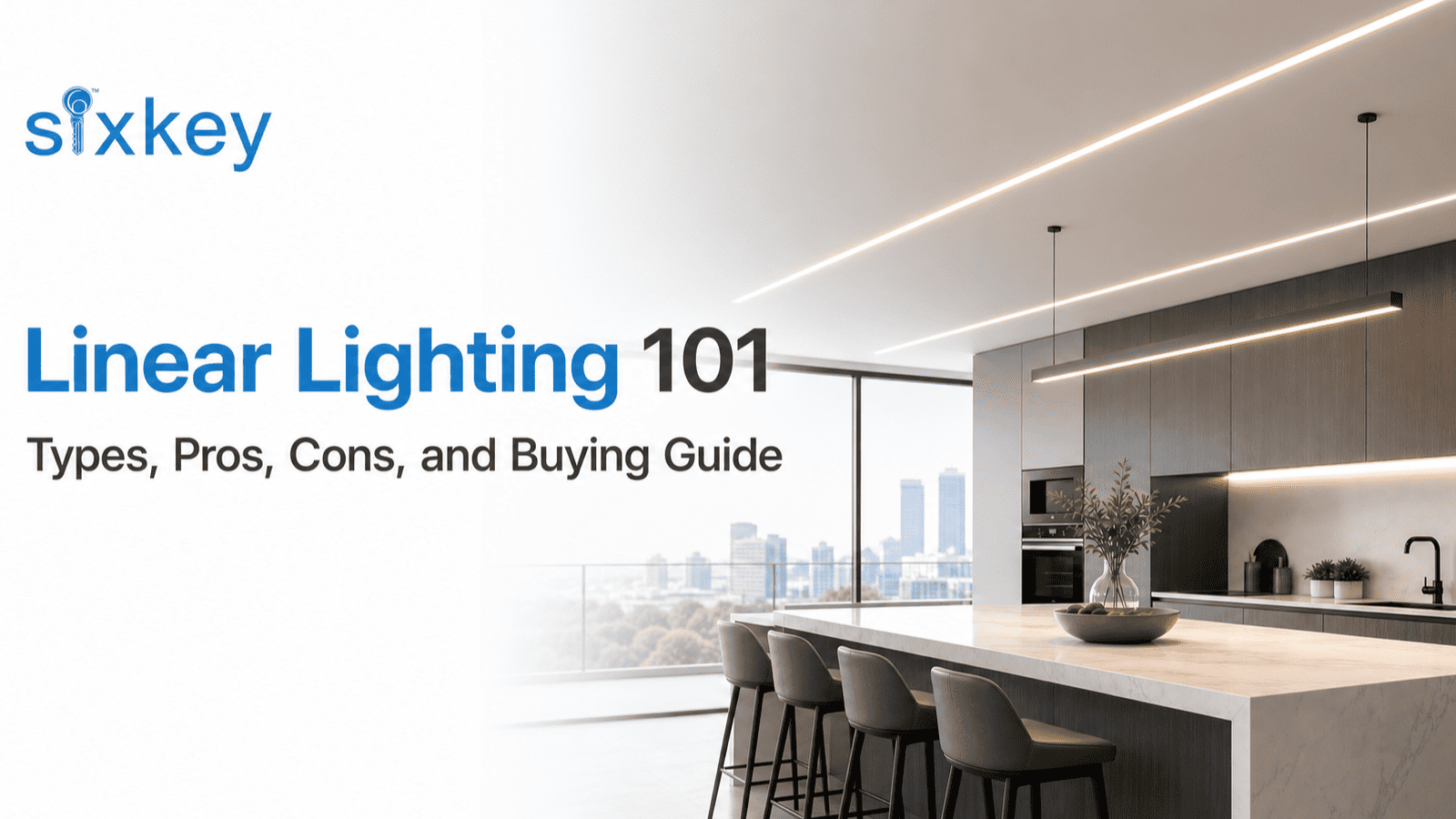
Linear lighting is a lighting format that runs light along a continuous line rather than concentrating it at a single point. Instead of one bulb radiating outward from a fixture’s center, linear lighting distributes its output across a strip, bar, or channel, producing a wash of even illumination along a countertop, hallway, or ceiling run.
This guide covers what linear lighting is, the types of linear lighting on the market, how linear lighting compares with non-linear lighting, the real advantages, along with what to check before buying linear lighting for your home.
In this guide
What is Linear Lighting?
Linear lighting refers to any fixture or lighting system in which the light source, or the fixture’s overall form, extends along an elongated line rather than radiating from a central point. The category spans flexible LED strips tucked under kitchen cabinets through to sculptural suspended chandeliers spanning a dining table. This elongated geometry lets a fixture mirror the shape of the surface beneath it, whether that’s a kitchen island, a run of crown molding, or a corridor ceiling.
Linear lighting handles all three layers of a typical lighting plan. Installed in a ceiling cove, it serves as ambient lighting, casting a soft glow across the room. Mounted under a cabinet, it becomes task lighting for a countertop. Angled to graze a textured wall or highlight a piece of art, it shifts into accent lighting. Few other lighting formats flex across all three roles this easily.
Types of Linear Lighting
Linear lighting breaks down first by physical format and second by light-source technology. Both distinctions affect what you can do with a given product.
Linear Lighting Formats
LED strips, also called tape lights, are flexible circuit boards lined with small LED chips and covered with an adhesive backing. They can be cut to length, bent around corners, and fit into tight spaces such as under-cabinet channels, closet shelves, or cove moldings, making them the most adaptable linear format on the market.
Surface-mounted bars are rigid aluminum or metal housings that hold an LED strip or integrated diode array and mount directly to a ceiling, wall, or the underside of a cabinet. The housing diffuses and directs light more evenly than a bare strip, giving the installation a finished, low-profile look.
Recessed and regressed channels sit within a routed groove in cabinetry, drywall, or a ceiling, so the light source disappears into the surface, leaving only the glow visible. This format delivers the cleanest architectural look but requires the most planning during construction or renovation, since the channel must be in place before the fixture is installed.
Suspended linear pendants and chandeliers hang from the ceiling on cords, rods, or chains, ranging from minimalist single-line bars to elaborate multi-drop compositions with light elements suspended at varying heights. These fixtures function as decorative focal points as much as they do as light sources, and they dominate the space above dining tables, kitchen islands, and reception desks.
Browse our chandelier collection for suspended options.
SMD vs. COB LED Technology
Surface-mounted device (SMD) strips place individual LED chips at set intervals along the strip. Chip-on-board (COB) strips pack a much higher density of diodes into the same length. The practical difference comes down to whether the strip will be seen or hidden.
| Properties | SMD | COB |
| Light Appearance | Visible dots at close range | Smooth, continuous glow |
| Best Use | Hidden behind a diffuser or in a deep channel | Exposed, where the strip itself is seen |
| Cost | Lower | Higher |
Behind a diffuser or inside a deep channel, SMD is fine, and you’re paying for nothing extra. Exposed along a shelf edge or a stair tread, the dot pattern shows, and COB is worth the premium.
Linear vs Non-Linear Lighting
Non-linear lighting, more precisely called point-source lighting, refers to any fixture in which light radiates outward from a single concentrated source: a pendant with one bulb, a recessed can light, or a table lamp. Point-source fixtures create pools of light with a bright center and a gradient that fades toward the edges, which works well for drama and focal points but leaves uneven coverage over an elongated surface.
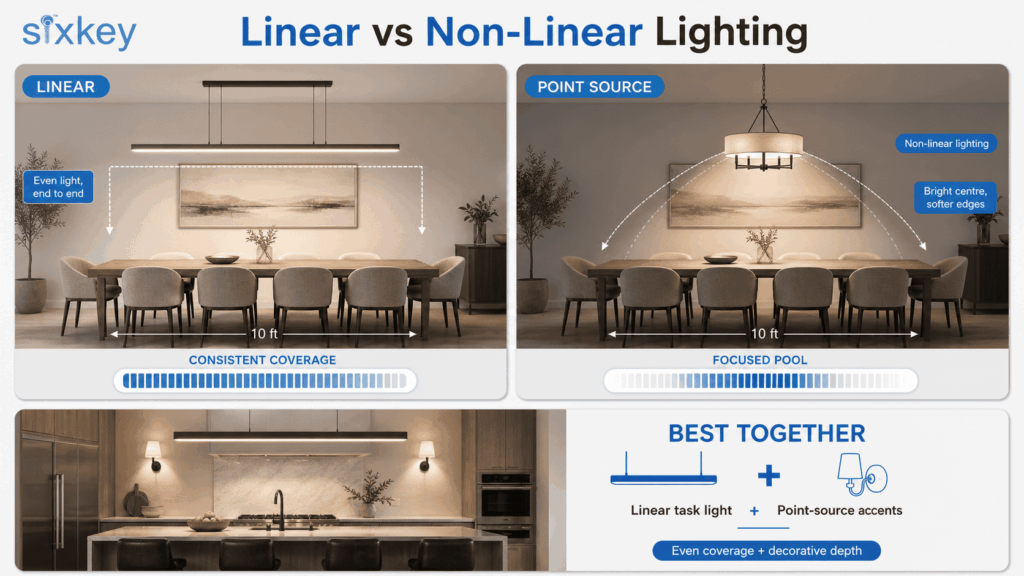
Linear lighting solves that unevenness by spreading the source itself across the surface it illuminates. A linear fixture positioned above a ten-foot dining table delivers consistent brightness end to end. A single point-source chandelier above the same table lights the center brightly and leaves the ends comparatively dim.
Neither format replaces the other, and most well-designed rooms use both. Linear fixtures anchor the primary illumination across a work surface or ceiling plane, while point-source fixtures like sconces, table lamps, or small pendants add contrast, warmth, and visual interest in the layers above and around it. Pairing a linear chandelier over an island with point-source sconces along an adjacent wall is a common combination in kitchen design, delivering both even task lighting and decorative depth.
Linear Lighting Pros and Cons
The trade-offs aren’t symmetrical. Linear lighting wins on coverage and adaptability, and it costs you in planning, wiring discipline, and dimmer compatibility.
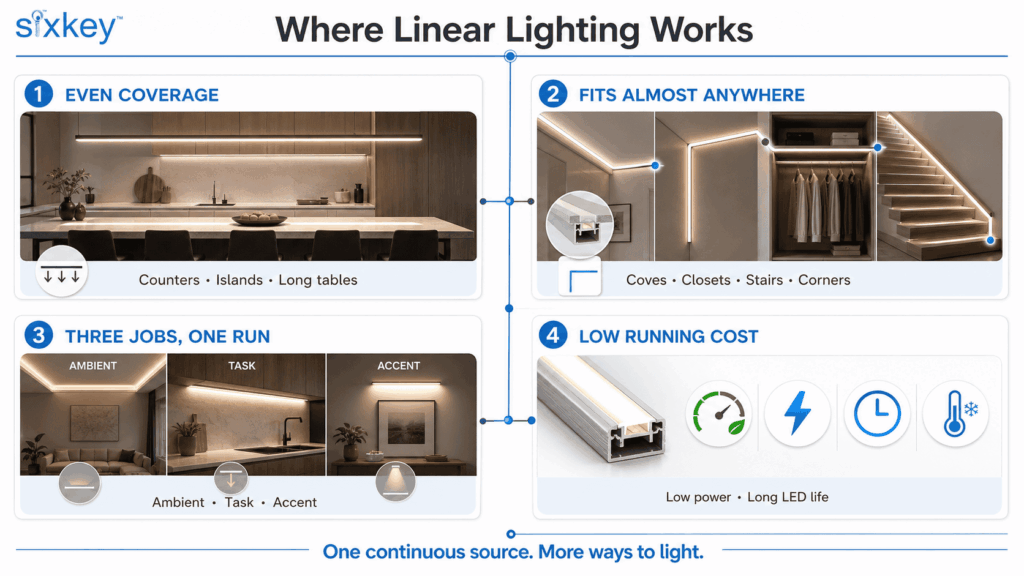
Where Linear Lighting Works
- Even coverage. A linear fixture spreads light across its full length, cutting the shadows a single point-source fixture leaves behind. That matters most over countertops, islands, and long dining tables, where the shadow falls exactly where you’re working.
- Fits almost anywhere. Strips cut to length and bend around corners, fitting into coves, closets, and stair treads a fixed fixture can’t reach. Recessed channels disappear into the surface entirely.
- Three jobs, one run. Ambient, task, and accent lighting from the same fixture, depending on placement and angle. That simplifies planning in kitchens and open-plan spaces.
- Low running cost. LED sources draw a fraction of the power of the incandescent and halogen fixtures they replace, and they run for tens of thousands of hours rather than the hundreds an incandescent bulb manages.
Where It Falls Short
- Voltage drop on long runs. LEDs farthest from the power supply receive less voltage than those closest, causing dimming, flicker, or a visible color shift toward the end of a strip. Fix it with a power injection point partway along the run, or a heavier-gauge wire. Check the manufacturer’s maximum run length before you cut anything.
- Dimmer compatibility. This trips up more buyers than any other spec. Fixtures use either 0-10V or TRIAC/ELV protocols, and the two aren’t interchangeable. TRIAC works within a narrower range and can flicker or buzz at low levels. 0-10V dims more smoothly but needs a separate control wire and a matched driver.
- Recessed formats need planning. The channel has to be routed into cabinetry or drywall before the room is finished, so retrofitting one is far more disruptive than adding a strip after the fact.
- Batch color mismatch. Color temperature varies slightly between manufacturing batches, so a run assembled from multiple strip sections can show a visible mismatch. Buy the whole run from one batch where you can.
- No re-lamping. Most integrated linear fixtures can’t be re-bulbed. When the diodes fail, the fixture goes, not the bulb.
Buying a Linear Lighting: What to Check First
Match the format to the application before anything else. Flexible strips suit tight, irregular, or curved spaces. Surface-mounted bars suit exposed runs where a finished housing improves the look. Recessed channels suit new construction where the groove can be built in. Suspended pendants suit dining tables, islands, and entryways where the fixture is meant to be seen.
- Size suspended fixtures against the surface below. A linear pendant or chandelier should run roughly one-half to two-thirds the length of the table or island beneath it. Undersized fixtures look stranded. Oversized ones dominate.
- Check CRI wherever color accuracy matters. A Color Rendering Index of 80 or above is the baseline for general residential use. 90 or above is the standard for kitchens, art display, and any space where accurate color perception affects the outcome, from judging produce freshness to evaluating a painting’s true hues.
- Match color temperature to the room’s function. Warm white in the 2700K to 3000K range suits living rooms, bedrooms, and bathrooms. Neutral to cool white in the 3500K to 4000K range suits kitchens, offices, and task-heavy workspaces, where clarity takes priority over ambiance. Nepali buyers have shifted toward warm white for living and sleeping spaces over the last few years, one of the changes in home lighting we tracked for 2026.
- Confirm lumen output against purpose. Ambient and accent applications need less output than a work surface does. Task-focused runs over islands and desks need the most, adjusted up for larger rooms and down where pendants or recessed cans already contribute.
- Verify the IP rating in damp locations. IP44 handles occasional splashes and light moisture, enough for some bathroom applications. IP65 or higher is required for direct water exposure, such as near a shower or in an outdoor-adjacent space.
- Size the driver with headroom. Total the wattage of the full run and pick a driver rated above it, not exactly at it. A driver running at its ceiling runs hot and fails early.
- Respect the voltage drop and dimming limits. Confirm the manufacturer’s maximum run length and budget for injection points beyond it. Check whether the fixture is 0-10V or TRIAC/ELV, and match the dimmer to it. Mismatched pairs flicker, buzz, or lose most of their dimming range.
- Budget realistically. Expect Rs 3,000 to Rs 7,600 per linear foot for LED strip or tape product, and Rs 1,050 to Rs 3,050 per linear foot for professional installation of under-cabinet or architectural runs. Suspended linear chandeliers vary far more widely, from budget aluminum fixtures to hand-finished designer pieces.
Where Linear Lighting Works Best
Linear lighting has moved from a commercial specialty to a mainstream residential choice, and the market is growing at roughly 11 percent a year through 2035. The reason it keeps spreading is simple: certain rooms have problems only a continuous line of light solves.
Bathrooms use linear lighting around or behind mirrors for shadow-free grooming light. Positioning the source at eye level, rather than solely overhead, cuts the harsh under-eye shadows a single ceiling fixture creates during shaving or makeup application.
Living rooms and hallways use it in coves and along ceilings for ambient wash lighting that guides movement through the space. In open-plan layouts, a continuous run along a ceiling perimeter visually separates a seating area from a dining area without adding walls. Offices apply the same logic overhead, where the wider, softer spread causes less screen glare than a directional fixture above a monitor.
Retail and commercial spaces lean on linear lighting for even, brand-forward illumination that keeps product displays and signage sharp, particularly when paired with a high-CRI strip that renders merchandise colors accurately.
FAQs Related to Linear Lighting
What is linear lighting used for?
Linear lighting delivers ambient, task, and accent lighting from a single continuous fixture. Homeowners use it under kitchen cabinets, above islands and dining tables, in ceiling coves for ambient glow, behind bathroom mirrors, and along hallways and stair treads for both illumination and safety.
What is the difference between linear and non-linear lighting?
Linear lighting spreads its light source along a continuous line, producing even coverage across a surface. Non-linear, or point-source, lighting radiates from a single origin, creating a bright center that fades toward the edges. Most well-designed rooms combine both for layered results.
Is linear lighting more expensive than traditional fixtures?
It depends on the format. LED strips and tape lights run Rs 3,000 to Rs 7,600 per linear foot plus installation, often cheaper than multiple traditional fixtures covering the same area. Suspended linear chandeliers vary widely, from budget-friendly aluminum designs to high-end sculptural pieces costing significantly more than a standard pendant.
Can I install linear lighting myself?
Plug-in LED strips and surface-mounted bars are manageable DIY projects for anyone comfortable with basic wiring. Recessed or regressed channels and any hardwired suspended fixture that requires a new junction box should be installed by a licensed electrician to meet code requirements and ensure proper voltage management.
Why does my LED strip look dimmer at one end?
This is voltage drop, a common issue on long runs where LEDs farthest from the power supply receive less voltage than those closest to it. Either keeping the run within the manufacturer’s specified maximum length or adding a power injection point partway along the run resolves the issue.
Ready to Shop Linear Lighting?
Linear lighting earns its place in kitchens, hallways, and dining rooms because it solves a problem point-source fixtures can’t: even, shadow-free coverage across a long surface. Match the format to your application, confirm CRI and color temperature against the room’s purpose, and settle voltage drop and dimmer compatibility before you order.
Sixkey stocks strips, channels, and suspended linear fixtures sized for Nepali homes and workspaces. Browse the linear lighting collection to compare formats, or if you’re unsure which run length, driver, or color temperature fits your space, reach out before you buy. Call or message us at 9856028462 or use the contact form, and we’ll spec it with you.